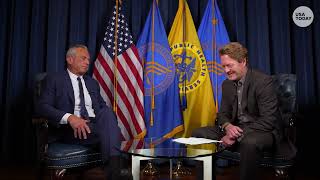
Robert F. Kennedy Jr.
rfk jr moves between health policy, dietary certainties, and the spaces where science meets skepticism
Robert Francis Kennedy Jr. (born January 17, 1954), also known by his initials RFK Jr., is an American politician, environmental lawyer, author, conspiracy theorist, and anti-vaccine activist serving as the 26th United States secretary of health and human services since 2025. A member of the prominent Kennedy family… wikipedia →
12-month trajectory
recent news
cooking show launch
- Roadkill, anyone? RFK Jr. launches a cooking show. - Daily Kos
- RFK Jr launches MAHA cooking show - Fox News
- Trump presses RFK Jr. for more autism research during Cabinet meeting - Washington Examiner
+ 26 more
rfk jr health policy
- FDA weighs a new kind of flu shot based on technology RFK Jr. has questioned - NPR
- Opinion | RFK Jr. shows how not to avoid a conflict of interest - The Washington Post
- Fact or Fiction: RFK Jr. launches a cooking show? - 10News.com
+ 6 more
rfk jr conflicts of interest
rfk jr and trump relationship
satire and commentary
- RFK Jr. Compares President Trump to His ‘Transparent’ Uncle, John F. Kennedy - Yahoo
- RFK Jr. Cooking Show Features Easy Weeknight Meals Using Ingredients Already In Own Body - theonion.com
- Celebrity Chef Busted as MAGA in RFK Jr.’s Cooking Show - Yahoo
+ 9 more
cooking show nutrition focus
dispatch
robert f. kennedy jr. is one of those figures who forces you to hold two things at once — the legacy he was born into, and the institutions he's spent the last decade actively undermining.
he came up in the most mythologized family in american political history. son of bobby kennedy, nephew of jfk, grew up inside a story that the country was still writing. his early professional life pointed somewhere serious — assistant district attorney in manhattan, then environmental law, real environmental law. he spent years building out riverkeeper and the waterkeeper alliance, litigating against polluters, doing the kind of unglamorous advocacy that doesn't get you on magazine covers. there was a version of rfk jr. who was going to be remembered as one of the more effective environmental lawyers of his generation.
then came the pivot. by the mid-2000s he was deep into vaccine skepticism, and by the time covid arrived he had built children's health defense into one of the most visible anti-vaccine organizations in the country. his 2021 book on anthony fauci became a bestseller in certain circles. he ran for president in 2024, briefly, first as a democrat, then as an independent, before endorsing donald trump and withdrawing from the race. in february 2025, the senate confirmed him as secretary of health and human services, 52 to 48, against significant opposition from medical organizations and public health researchers.
what makes him the name right now is the combination of office and agenda — the friction between institutional power and the beliefs he's carried into it. a former cdc official said recently that his response to the ongoing measles outbreak is, quote, "not based on science or reality." that's not a fringe critique coming from outside the system; that's someone who ran operations inside the agency he now oversees. separately, there's a federal campaign under his watch that's discouraging antidepressant use — the details are still developing, but the concern from clinicians is real and specific: that messaging designed to reduce pharmaceutical dependence, without adequate nuance, pushes people off medications they need. and then there's the beef tallow conversation, which sounds almost comic until you remember it's coming from the person setting national nutrition priorities. cardiologists have been fairly direct about the gap between his certainty and what the evidence actually shows.
the nyt had a piece recently asking whether the maha movement — make america healthy again, his signature phrase — has already lost its coherence. it's a fair question. the movement was always a loose coalition of people who distrust pharmaceutical companies, processed food, institutional medicine. some of those concerns are legitimate and have been underserved by mainstream discourse. but translating that distrust into policy is a different thing entirely, and what's emerged so far looks less like a coherent public health agenda and more like a series of provocations.
what's genuinely interesting about kennedy, and what makes him hard to dismiss with a single frame, is that his environmental record was real. the skepticism about regulatory capture, about the relationship between industry and the agencies meant to police it — that's not invented. but somewhere along the way, the skepticism became the point, rather than the means to an end. and now he holds one of the most consequential positions in american public health, at a moment when measles is resurging and institutional trust is already thin.
that's the tension that keeps his name in circulation. not the tabloid stuff, not the beef tallow. the question of what happens when genuine grievance and genuine misinformation wear the same coat.